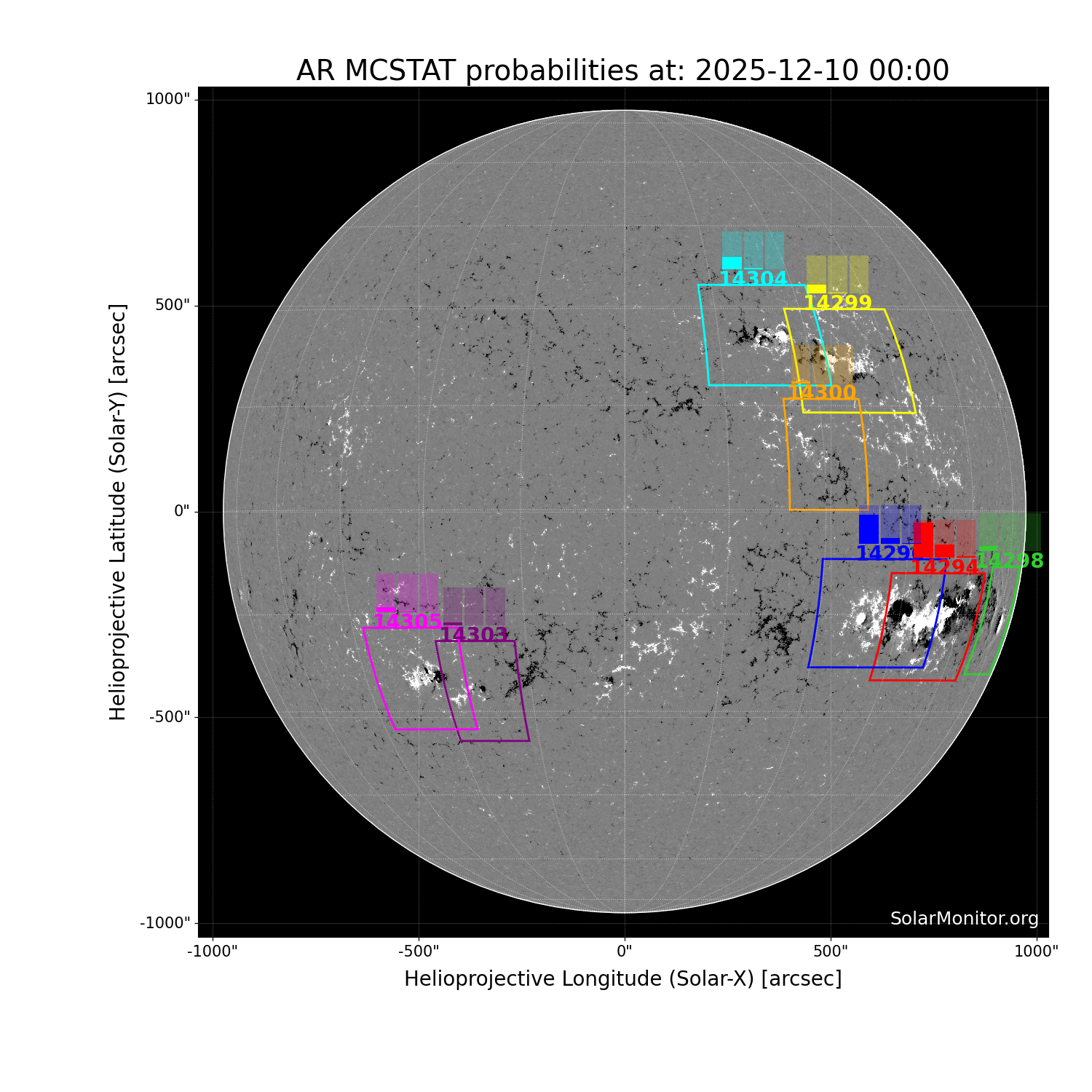
Flare Probabilities [%] (00:00 UTC +24H) ?
| NOAA ? | C+ | M+ | X+ | Mean ? | ||||||||
|---|---|---|---|---|---|---|---|---|---|---|---|---|
| MCEVOL ? | MCSTAT ? | SWPC ? | MCEVOL | MCSTAT | SWPC | MCEVOL | MCSTAT | SWPC | C+ | M+ | X+ | |
| 14294 | 95 | 92 | 95 | 67 | 35 | 55 | 19 | 5 | 5 | 94 | 52 | 10 |
| 14296 | 86 | 76 | 50 | 42 | 15 | 10 | 8 | 2 | 1 | 71 | 22 | 4 |
| 14298 | 13 | 15 | 15 | 1 | 2 | 1 | 0 | 0 | 1 | 14 | 1 | 0 |
| 14299 | 48 | 22 | 15 | 0 | 2 | 1 | 0 | 0 | 1 | 28 | 1 | 0 |
| 14300 | 4 | 5 | - | 0 | 0 | - | 0 | 0 | - | 4 | 0 | 0 |
| 14303 | 10 | 8 | 5 | 1 | 1 | 1 | 0 | 0 | 1 | 8 | 1 | 0 |
| 14304 | 13 | 33 | 55 | 0 | 4 | 10 | 0 | 0 | 1 | 34 | 5 | 0 |
| 14305 | - | 14 | 50 | - | 1 | 10 | - | 0 | 1 | 32 | 5 | 0 |
SolarMonitor's flare prediction system's probabilities are calculated using the NOAA Space Weather Predicion Centre's McIntosh classifications. There are two methods, MCSTAT and MCEVOL, that use sunspot-group McIntosh classifications and Poisson statistics to calculate flaring probabilities valid for a 24-hr period starting at 00:00 UTC. The flaring probabilities are calculated using historical data from solar cycles 23 and 24 (1996-2019).
MCSTAT (McIntosh Statistics): Uses the point-in-time McIntosh classification to calculate Poisson flaring probabilities. Details about the method [1] and forecast verification testing [2] can be found in the following papers:
[1] Gallagher, P. T., Moon, Y.-J., Wang, H., Solar Physics, 209, 171, (2002)
[2] Bloomfield et al., 2012, The Astrophysical Journal Letters, 747, L41
[1] McCloskey, A.E., Gallagher, P.T. & Bloomfield, D.S., Solar Physics, 291, 1711, (2016)